Gold-filled jewellery has a karat-gold alloy layer mechanically bonded to a base-metal core, rather than being made entirely of gold. Under US jewellery guidance, “gold filled” generally requires that layer to comprise at least 1/20 (5%) of the item’s metal weight. A mark such as “1/20 14K GF” identifies the proportion of 14K gold alloy, not pure gold.
How does it compare with plated or solid gold?
Gold plating is usually a thinner electroplated coating, while solid 14K gold is a 14-karat alloy throughout. Gold-filled jewellery can resist surface wear better than thin plating, although durability depends on friction and construction. The karat number describes the gold alloy’s fineness; it does not, by itself, establish the coating’s thickness.
Are clasps and connecting rings gold filled too?
Check whether the chain, clasp and connecting rings share the same material: mixed components are possible. For gemstone bracelets and anklets, confirm the named stone, clasp and actual length or extension range. A product title alone does not establish every component’s specification; request clarification before ordering if the details are missing.


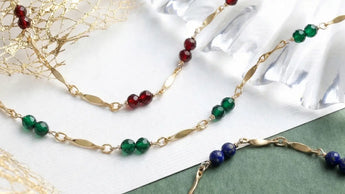

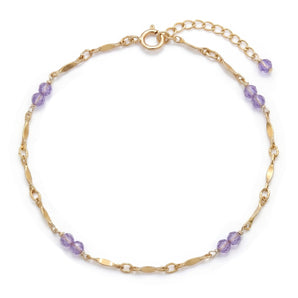 Rila อเมทิสต์สีลาเวนเดอร์ สร้อยข้อเท้า (February อัญมณีประจำเดือนเกิด)

 Rila เพอริดอต สร้อยข้อมือ (สิงหาคม อัญมณีประจำเดือนเกิด)

 Rila อะความารีน สร้อยข้อมือ (มีนาคม อัญมณีประจำเดือนเกิด)

 Rila Emerald สร้อยข้อมือ (พฤษภาคม อัญมณีประจำเดือนเกิด)

 Rila ไพลิน สร้อยข้อเท้า (September อัญมณีประจำเดือนเกิด)

 สร้อยข้อเท้าโกเมน Rila (อัญมณีประจำเดือนมกราคม)

 Rila ลาพิสลาซูลี สร้อยข้อมือ (ธันวาคม อัญมณีประจำเดือนเกิด)

 Rila ซิทริน สร้อยข้อมือ (พฤศจิกายน อัญมณีประจำเดือนเกิด)

 Rila Pink ทัวร์มาลีนสีชมพู สร้อยข้อมือ (ตุลาคม อัญมณีประจำเดือนเกิด)


 Rila Ruby สร้อยข้อมือ (กรกฎาคม อัญมณีประจำเดือนเกิด)

 Rila ลาบราโดไรต์ สร้อยข้อมือ (มิถุนายน อัญมณีประจำเดือนเกิด)


